Local writer Millie Reinhardsen was inspired by Imogen Cunningham’s 1959 photograph, ‘Children in Doorway’ and the sentence “What we love and remember most about our mother is her serial killer’s patience.” In this short story, Reinhardsen explores how the two seemingly opposite materials could be combined.
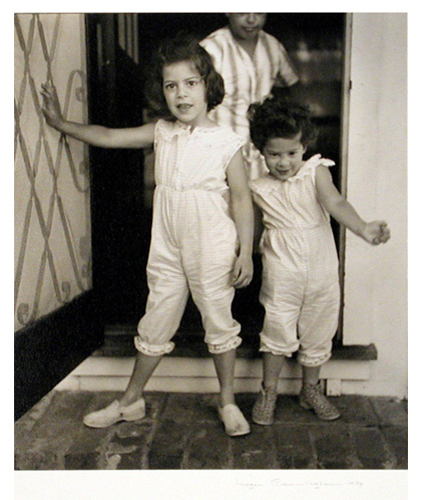
Imogen Cunningham (U.S. 1883 – 1976). Children in Doorway. 1959. Gelatin silver print. Henry Art Gallery, Gift of Gryffyd and Janet Partridge, in memory of Imogen Cunningham, 96.9
Children in Doorway, 1959
Millie Reinhardsen
What we love and remember most about our mother is her serial killer’s patience. That soothing, silent thrum. For despite everything people have said about what she did, never once—before or after—did she allow us to see her cry, or scream, or slur through any locked or open door. She remains as cool and poised as a pond in winter.
Especially in our memories of the new house, the one from the photograph. If she ever wavered, regretted it, we’d never find evidence in our mind’s eye. It was as though she had stepped straight from our home into that small squished shoebox and without even a second breath, just—continued. So we did. Despite the new house being everything the old one wasn’t.
For one thing, it was hot. Sweltering hot. Unbearably hot. It was the heat that woke us that first day, not her. We were suffocating. The light was so dim it appeared as though the dark was merely stained with it, blotted tea drops on a tablecloth. We strained to see through it, knowing in our little selves that we were somewhere else, somewhere where the light and the heat and the air was different, and our mother was nowhere to be known. But then she was there, before we could truly doubt it. Swooping out of the gloom, her gray dress, pressed smooth for church, billowing as she dropped onto the sunken mattress next to us. Her hair was still coiffed, her pale dry skin luminous. Her shoes were off and her toes, chipped and faded red, swathed only in cotton pantyhose.
We’re living like tigers, was the first thing she’d said. Tigers in a jungle, where it’s hot and dark and we can do whatever we want—doesn’t that sound like fun?
It did. Of course it did. If it just wasn’t so hot! We flopped about on the shared mattress that was planted in the middle of the dusty living room and not a bedroom, squirmy and cranky. Lisa wanted her Sunday dress off and our mother helped free her, then me. For a moment, we forgot the heat as we wriggled around, giddy in only our silly, frilly white bloomers and shoes.
We noticed then the light was not so dim after all but only so because of the many colored sheets and towels stretching over every closed window and shutter. They were illuminated with the rest of the hot outside to protect us, puffed sails of stained glass. The sheets were ours—Lisa’s peony pink, my new cream cotton with the yellow daisies. We ran to them and patted them to as if to acknowledge, to assure, ask. The towels were hers. The fancy guest set she no longer took out of the closet. Soft and white and with hers and our father’s embroidered initials curling like dried orange rinds. She’d brought these. All of these and tacked them to the cracked wooden sills with small rusty nails that angled in every which way. We touched the towels disbelievingly.
“Mind the nails,” our mother had said. “Don’t touch them because you could hurt yourself and get infected very badly.”
“Here’s one,” I said, picking one up from the kitchen floor, dirty yellow tiles with speckled black around their rims. She held out her pale smooth hand and when I dropped it into her hand, the red rust left stains on my fingers and her palm.
“Be careful, there might be more. Keep your shoes on. We won’t be here long.”
“Where are we going?” Lisa said, stepping into the kitchen and pressing into our mother’s skirt.
“Somewhere good. Not here.”
“Not home?” I said, moving to the ancient gas stove and petite turquoise fridge with a tarnished silver. I gave it a tug but it was rusted shut.
“No. Somewhere better.” She slipped the nail into her dress pocket and smoothed it down again. “Are you hungry?”
We were, her questioning suddenly, muddily, reminding us we hadn’t eaten since breakfast. We were not even sure of what time it was now—was church over? It must be, we wouldn’t be here otherwise. That would’ve meant we missed it, or slept through the entire service. Sometimes that happens when it’s summer and the air is boiling. I’m sure now that’s why we always sit in the very back pew instead of the front with Grandma and all her friends who turn around occasionally to make sure we’re still paying attention. Once during the first few times we took to sitting in the back, I heard a snore from the other side of our mother and looked over to see Lisa sprawled out like a polar bear sunbathing at the zoo: her head rolled back, her belly protruding against her dress, her little tongue lolling over her lower lip. Our Uncle Evan, our mother’s brother, who still going to church with us then, started shaking so bad, a great honking snort escaped his pressed lips and the entire church swiveled around in time to see Lisa wake with a start. On the car ride home, Uncle Evan said to our mother who had ten white knuckles on the steering wheel, “Ava, you’ve got to admit. It was pretty damn funny. Best thing I’d seen since being home.”
But even still, he stopped going a few times after that. Wouldn’t even come out of the auto body shop he lived over when we pulled in on Sundays. Our mother tried knocking on the door, peering through greasy shop windows and up at the closed, rippling curtains, her white heels pressed neatly together. After sliding back into the car, she’d always throw a smile at us in the backseat as if to say, Oh that silly Uncle Evan. You know. Eventually, we stopped going to the auto body shop altogether and exactly one month ago, Grandma started wearing black to church. We didn’t know it was her at first, because of the veil and because she stopped by our pew on her way in. She took Lisa and I in with a small nod, a dark shadow solidified against the wave of bright color and pattern milling behind her. Her face was hidden but I could tell she stared at Uncle Evan’s empty spot for a moment before addressing our mother in a soft, stiff tone, “Be sure that Paul doesn’t take a leaf out of Evan’s book, Ava. God knows he’s taken many out of Paul’s.” And she moved on without waiting for an answer. When we asked what book our father and Uncle Evan had, she said it was a book called “Nam” and that no, we could not get it for bedtime.
Or maybe it was the pancakes this morning, not just the heat. What a treat, those pancakes! Usually they were only for birthday breakfasts and we pestered her all morning whose birthday it was—no ours, not hers or our father’s, Uncle Evan’s, Grandma’s, the cat’s…
“It’s the birth of a new day,” our mother had said. “Eat up, sweetheart so we can make it on time.”
We gorged ourselves, squabbling over the last halves our mother divided for us while she never got a bite herself. I definitely got the bigger half, despite what Lisa may think, and I began to feel the impact of its richness as we pushed our socks into our shoes, groaning in anticipation of the long hot service before us. I barely remember leaving the house, the brightness of the day clanging off the sidewalk and windows of the car; our mother making sure we were both securely buckled in the backseat before sliding into the front, a black head scarf knotted under her chin, a pair of big black sunglasses slipping over her face.
**
We ate out of cans like cowboys. The maple brown sugar sauce and beans running down the sides and onto our hands. Our mother had plucked three cans from a small pile of canned goods stacked neatly under the kitchen’s only window covered by a blue towel. She pulled a can opener and three spoons from her handbag and we took turns sharing her black headscarf from the morning as a napkin. When we finished, we were suddenly rejuvenated by the place, how we could draw pictures into the dust that covered everything—the walls, the tiles, the bathroom and kitchen counters; how we could sprint at full speed across the living room and leap onto the mattress that heaved and dipped as we landed one at a time, shrieking with laughter; how the ants parading the edges of the room could be coaxed out and lured by small dots of maple brown sugar sauce across the room and into various weaves and circles. Never before had we’d been allowed to do anything of these things. It was the jungle.
Our mother took our Sunday dresses and rolled them up tightly, stuffing them into a large picnic basket she produced from nowhere. It was new, the wooden weave smooth and strong, the inside cloth patterned with teddy bears and tulips. It was packed full of our stuff—two pairs of shoes and socks and shirts and sweaters (Lisa’s and mine), a thermos, full and heavy; a knife wrapped in layers of plastic wrap, candy bars, three forks (and now the three spoons and can opener), a box of crayons and sketchpad, a road map, Lisa’s stuffed lamb, my elephant; a road map, a pill bottle, filled, with the label ripped off and a fat envelope she wouldn’t let us open.
Again we asked, where are we going? Is Daddy going to be there? Why are we leaving? I don’t know, no, and because we have to.
“Why?” I said pulling out the box of crayons as Lisa pulled Lamb out by a leg and settled herself in our mother’s lap.
“Because it doesn’t make sense for us to be there anymore.”
“Is Daddy sick?” Lisa asked.
“In a way and he doesn’t want help. Just like Uncle Evan didn’t want any.”
“He didn’t want to go to church anymore,” I said.
“Yes.” Her hand was resting Lisa’s head but not seeming to realize it. “That’s part of it.”
I took out the thermos with both hands and pulled off the cap.
“Be careful, Lindsey, it’s hot—”
The screw cap inside suddenly popped off and water splashed out in the direction of Lisa and Lamb. The drops fell into the carpet steaming and Lisa shrieked as though they had all landed on her, kicking in our mother’s lap. Our mother gave a cry like a champagne glass breaking and her hand leap for her skirts.
“Lisa! Up, sweetheart—please!” She took Lisa under her arms and pulled her to a stand. Then grabbed the hem of her dress and it pulled all the way up till we could see a dark stain spreading across the top of her thigh, under the netting of her pantyhose, the brown, burnished nail stapling the skirt to her skin.
She shoved her skirts down before we could get a good look and was up on her feet, unsteadily but determinedly moving into the kitchen, her back to us, one hand grasping along the edge of the counter until it reached the end, directly facing the towel-shuttered window. Her pale neck dipped forward. Flew back up. Her fist clenched tightly.
“Lindsey, the scarf. By the mattress.”
I ran for it. It smelled of beans and was crusty in patches. When I handed it to her, she took it and then pressed a pale hand to my forehead so I wouldn’t lean forward and see the running red soaking her gray skirts black.
“Don’t look, Lindsey.”
She was reaching under her dress now, swiftly wrapping, her shoulders rocking.
“Mama!” Lisa screamed piercingly from the living room.
“Stay where you are, Lisa. Mama’s fine.” But her skin was near translucent, the first beads of sweat I’d ever noticed on her bejeweled her hairline. She kept closing her eyes and breathing hard and then opening them and breathing hard again.
A splinter of blinding sunlight squeezed through the space between towel and window glass then and appeared down her face, the brown in her eye a glowing amber gem as she stared unblinkingly into it.
“I need to leave,” she said. “To get help. Do you understand what that means? You and Lisa need to stay here by yourselves and be brave and be quiet and know that I will come back.”
She was moving away, back to the living room where Lisa made to grab for her stained skirts but our mother stopped her and picked her handbag up from the floor and then her shoes.
“Mama!” Lisa screamed. She was crying fully now, drooling tears streaming down her face, her head thrown back and her eyes close. “MAMA!”
“Shhh Lisa. Be brave now. I promise I will be back. I promise. Remember that. Can you be a brave girl now? Yes? Yes? There we go. I love you.”
She kissed Lisa on the top of her head and then me and then the front door swung open, a fleeting flash of light and heat. “Don’t open the door for anyone, Lindsey. Hide if anyone comes.”
And she was gone.
The silence was absorbing. The very room collapsing and expanding at the same time. Lisa was still crying but only in silent blubbers. She walked over to the door and took ahold of the doorknob that wobbled like a plastic eyeball popped from a doll.
“Lisa, no! She’ll be back.” I walked over and pushed her hand away.
“I want Mama!” she shrieked.
“She’ll be back! You big baby.” I walked away from her, into the kitchen though I didn’t know where I was going, what I was looking for. The sunlit ray was still streaking across the gray wall and tiles and climbing onto a spindly metal chair, I hooked a finger into the fraying edge of the illuminated blue shade and peeled it even more away from the glass. Bleaching, bright, stinging light punched my eyes shut again. Then there was grass and ground, both brown and balding. A brown rusted top of a trashcan covered in a blanket of moss poked out from just below the sill and behind it a sagging chain-linked fence ran the width of the window and beyond. A brown wall rose in the distance behind the fence and I realized it was a building, a big building like a supermarket. The back of it anyways because I didn’t see any glass doors or bright letters across its face.
Then movement–and a cat! Brown and slinking across the chain-liked fence with a gray collar and a little silver tag that jingled. At first I thought it was Snow White but this cat wasn’t snowy white at all. It was brown, splattered black with enormous black eyes that reflected gold in the sunlight as it looked at me.
“What’re you looking at?” Lisa appeared in the kitchen, snot wavering inside both nostrils, Lamb squished under one arm.
“Nothing.”
“I want to see!”
“No! You’re not supposed to.” I slid off the chair and pushed it away from the window so she wouldn’t climb on.
“You did!”
“I’m allowed to. Mama said to keep watch.”
“No she didn’t!”
“Yes she did!” For some reason I felt the need to grab a hold of the tarnished silver handle of the old turquoise fridge and give it a tug. It opened. Stale air billowed out and I let go of the handle so that it snapped shut again. I seized it immediately and opened it, half-expecting dead rats or enormous spiders to come spilling out. But it was empty. Not even the shelves were left. Dust and spotted grim covered the cool white insides. It was big enough to fit Lisa and Lamb standing up but not me.
“It’s smelly,” Lisa said as I tried again to squish in besides her.
“Hold the door.”
“What?”
“Lisa! Hold the—“
I slammed my hand into the door’s curved inside just as the tarnished lock clinked off one but didn’t catch and secure. A hot white beam of light divided the two fridge halves, though it was only the dim light of the house.
“I said hold the door!”
“I didn’t know what you were talking about!” She shoved the door open and got out.
“I told you to hold it!”
“I didn’t know what you meant!” she screamed.
“Shh! Mama said to be quiet!”
“You’re not Mama! You don’t know!”
A cascading crash outside like two aluminum sides cracking together. A shadow darted from the blue towel in the kitchen and then a screeching meow.
“Mickey!” A man’s tinged with an accent, like Speedy Gonzales.
Another shadow—two!—slanted across the blue towel in the kitchen and we watched as they stretched the narrow width of the window and disappeared, only to curve again around the towels in the living room.
“Mickey!” A different voice, another man’s, younger, same tinge in accent.
A crash into the wall and another yowl. Lisa yelped and I slapped a hand over her mouth. The movement outside stopped. One shadow, stark and still, a toweled window; a black slash across golden. We watched as the shadow turned slowly, so the slash became the vague silhouette of a person bleeding through.
“Hello?”
My hand was still camped over Lisa’s mouth and she was so shocked, she didn’t even try to wriggle away.
The doorknob jiggled.
“Hello?”
“Shh,” I said unnecessarily to Lisa. We backed away and the turquoise refrigerator bumped into my shoulder.
“Get in,” I said to Lisa. “Shh—now!”
I pushed her in and she began to blubber but I pressed my first two fingers into her mouth and said, “Shh! Remember what Mama said—hide if anyone comes. Don’t make any noise until I say so, okay?”
She was clutching Lamb into her chest, backed into one rounded corner; tears streaming down her red round cheeks. I shut the door.
“Hello?”
A knock, meaningless, then the door burst open, flying; the sun thrown into the house like an enormous shard of glass. I raised an arm, covering it as two tall figures beat through the rays of light and entered the house, walked into the living room, noticed me, and stared at me. Still I could not see their faces.
“Whoa… Hello there.”
I didn’t answer, the sun searing into my eyes.
“Hello… What’s your name?…Is your mother around??”
The two figures moved forward and out of instinct I backed away, bumping into the turquoise fridge again, listening for Lisa’s blubbering but it was sealed away. The first figure, shorter and stouter, moved sharply, an arm thrown out, and the second, smaller and thinner, stopped. The first one said, “Stay back. Don’t frighten her. Go call somebody.” The second figure flitted away.
“Hello. Please don’t be scared. Where are your parents?” The black shadow was becoming a man, a pair of hairy arms, dark skin, dark eyes and dark hair. Like our father but shorter, stouter, cleaner, kinder. A white shirt with vertical orange stripes came roaring into focus.
“What’s your name? Is your mother around?”
Why does he keep asking that? Does he know? Does he know she was here just a little big ago and left to get her leg fix? Is he looking for her?
I backed around the far edge of the fridge until I was half hidden from him.
“No, no, please don’t be scared! We are going to help you. My son is calling the police. What’s your name? How long have you been here?”
A day. A Sunday. Or unless it was many Sundays, many days stuck like this and we never knew it.
“Are you hear alone?”
I clutched the fridge. Shh, Lisa. Don’t make a sound. Be here when Mama gets back. I won’t tell.
“Yes,” I said.
The man breathed an audible sigh. He even smiled a little bit.
“What’s your name?”
“Lindsey.”
“Lindsey. And how did you get here, Lindsey?”
What could I say? That I was dropped here? That I grew up here? I didn’t know what to say.
“Is your mother here, Lindsey?”
No. Not yet. But she would be. And would find Lisa in the fridge then and then come get me later.
“Lindsey, where are your parents?”
I don’t know. I don’t even know if Daddy knows we’re gone yet.
“DAD!”
The second figure was back.
“Dad! I called the police! They’re here—they’re on their way!”
And sirens, wailing, louder and louder as they screeched up to the house. The sound of doors opening and slamming, the crunching of shoes on gravel, on brick. And they were inside the house, a flurry of suits. I clutched the fridge, trying not to cry, thinking, Shh Lisa Shh. Whatever you do, don’t make a sound.
“Looks about right,” one of the suits was saying, rooting around the mattress, looking at the walls and patched windows, that in the real sunlight had faded until dark clots than sails. “I think this might be our girl.”
“Where’s your mother and sis, toots?” A suit was suddenly in the kitchen, looming and then dropping so his face was level with mine. A clean-shaved face and blue eyes like our mother’s stared at me.
“Sister?” The man in the orange-striped shirt behind him said. “We haven’t seen any sister!”
“Where is she?” the man said. “Don’t be scared. We’re here to help. Is she coming back? Where are they?”
“I don’t know,” I said.
“You don’t know? Did they leave without you?”
I nodded.
“Do you know where?”
No.
“Let’s get her in. And wait around until the mother comes back. C’mon, toots.” He took my arm, grabbed it, and tugged me away from the turquoise refrigerator—Lisa—and into the living room, towards the brilliant bright doorway.
“Wait, Reggie. The other girl’s got to be here. It makes no sense.” The other suit rose from the upturned mattress. “Search the premise. It makes no sense.”
He moved around the living room, checking the corners as if Lisa had been swallowed into the shadows, the bathroom (the tiles clinking and breaking with his every step), and finally the kitchen, looking into every cabinet, under the sink, the fridge—
It didn’t open. The rusted lock jammed again. I held my breath—Lisa don’t cry! Don’t cry! Don’t cry! Don’t cry!
The suit pulled at the handle again, harder until the fridge rock onto one side and an audible shriek seeped through the door. The suit yanked again. The fridge tilted, a muffled cry inside. Then still, tilting, the door popped open and Lisa came tumbling out, yowling. The suit caught her, pulled her upright. Her face was red, her eyes streaming. The suit looked triumphant.
“Ah ha! Here’s the second!”
“Mother must have locked her in,” the first suit, the one still holding my arm.
The second suit tried to pick up Lisa but she pulled away and ran to me, Lamb forgotten on the yellowing kitchen tires behind her.
“Reg, why? Why would she do that?” The second suit said, standing and moving into the living room. One bleep, then two from outside chirped and the second man said, “The press. They’re here. Bet they’ve already been to the hospital where the mother is.”
Mama! Lisa heard it too. Maybe she told the suits to come! But why then? Didn’t she want to come back and take us somewhere better?
Mama! Lisa and I ran for the doorway. Behind us the suits and the man in the striped orange shirt tried to stop us but we were the threshold, a heavy wood door with three toweled windows thrown open behind us, a mesh and steel frame leaning off to the side before us. We were on the brick threshold and—flash! More blinding than the sun itself. A roar from behind us, “Put that camera away!”
Another flash and my hand reached out, finding the mesh and steel door, the crisscross of the metalwork. Another flash.
“Get out of here!” The man in the orange stripe shirt right behind us, the suits behind him.
Lisbeth began to cry again.
In the photograph, the one with the new house, it could never be guessed she had cried that night. She looks almost giddy, giggly, a little smile curving up her cheeks and me, my hand pressed against the door, my mouth open as if to scream or smile. My eyes questioning. It’s an odd photo—I don’t think anyone just looking at it could guess what we went through that day, those weeks. The purpose, meaning of it hangs in the air, just out of reach. Lisa and I have never discussed that day, so many years ago now. She’s forgotten it, in a way. She remembers the canned beans, the leaping onto the mattress, our mother in her gray dress. We have never discussed why that photograph came to be, how we came to be photographed in our silly frilly white bloomers on a brick threshold with a man in a striped shirt in the background. What kind of picture is that? How does a photograph come to be? We haven’t discussed it and I suspect we never will. We haven’t seen our mother since. My vivid memory of her with the rust red nail in her thigh. The weight of the photograph teeters at the edges of our fingertips, on threshold of our understanding, caught in the act, of just departing or arriving.
Millie Reinhardsen earned her bachelor’s degree in Creative Writing from Western Washington University in 2012 and currently lives and works in Seattle. She cites T.C. Boyle and Wiley Cash as a few favorite authors. She plans to write more, publish someday and go to Australia soon. This story began in Anca Szilágyi’s Visual Inspiration class, which was co-presented with the Hugo House at the Henry this fall.






 Henry Art Gallery — Blog